Platforms
Decision Support System
Advanced geospatial analytics platform enabling data-driven insights for planetary science and Earth observation.
Launch EarthDigital Twins
High-fidelity simulations and digital replicas for understanding robotic behaviors and environmental processes through interactive experimentation.
Explore Digital TwinsAt a Glance
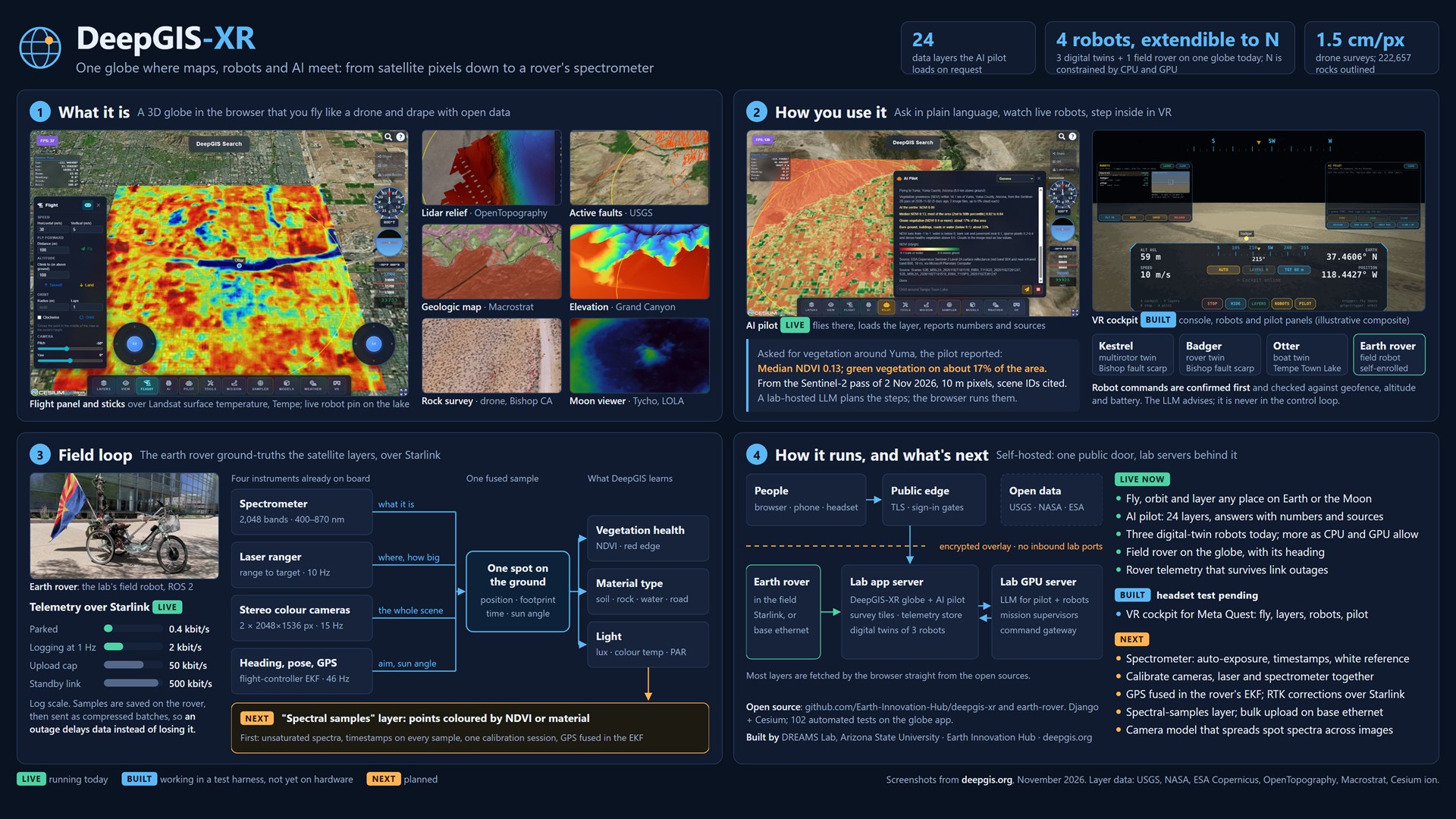
DeepGIS-XR puts open geospatial data, live robots, and an AI pilot on one 3D globe in the browser. The chart shows what runs today and what is being built next.
-
1 · The globe
Fly over Earth, the Moon, or another world like a camera drone. On Earth, 24 open data layers drape the view, from surface temperature and vegetation to lidar relief, faults, and drone surveys at 1.5 cm per pixel.
-
2 · AI pilot, robots, VR
Ask in plain language: the pilot flies there, loads the layer, and reports numbers with their sources. Three simulated robots and one field rover show live on the globe, and the fleet can grow as far as CPU and GPU allow. A VR cockpit for Meta Quest is built and awaiting its first headset test.
-
3 · Field loop
The EarthRover reports its position and telemetry over Starlink, storing samples on board first so a dropped link delays data instead of losing it. Next, its spectrometer, laser ranger, stereo cameras, and pose will be combined into ground measurements of vegetation health, material type, and light.
-
4 · How it runs
Self-hosted by the lab: one public entry point, with the application and GPU servers behind an encrypted overlay. The code is open source.
Explore the Solar System
Every world opens in the same 3D viewer, with the camera drone and the AI pilot. Beyond Earth, places go by their official IAU names.
Earth and the Moon
Our home planet with live data layers, and the Moon down to the Apollo landing sites.
Inner planets
The rocky worlds closest to the Sun.
Moons of Jupiter
The Galilean moons: the most volcanic world in the Solar System and icy shells over hidden oceans.
Moon of Saturn
Titan, the only moon with a thick atmosphere, and lakes and seas of liquid methane.
Pluto system
The dwarf planet and its largest moon, mapped by New Horizons.
DREAMS Laboratory
The Distributed Robotic Exploration and Mapping Systems (DREAMS) Laboratory at Arizona State University builds robotic systems and digital twins for mapping, sampling, and analysis in terrestrial, aquatic, and planetary environments. DeepGIS is developed in the lab.
-
Terrestrial
Ground and aerial robots and fixed sensors for geomorphology, drylands ecology, and agriculture.
-
Aquatic
Robotic boats and underwater vehicles for mapping and sampling lakes, coasts, and reefs.
-
Cyber-Physical Twins
Simulated and physical counterparts of robots and field sites, used to study and predict environmental processes.
-
Planetary
Surface feature mapping and digital twins of the Moon and Mars.
Acknowledgements
DeepGIS‑XR builds on concepts and systems originally developed for the Oceanographic Decision Support System (ODSS, MBARI), the Agricultural Decision Support System (AgDSS, University of Pennsylvania), the OpenUAV Project (University of Pennsylvania, Arizona State University), and DeepGIS (Arizona State University). The DeepGIS project acknowledges support from the National Science Foundation, the United States Department of Agriculture, and the National Aeronautics and Space Administration.



Banner image courtesy of NASA Apollo Mission (Image: S73-22871)